

Authored by: Leanne Hobbs, Strategic Advisor, Biointelect Venturer
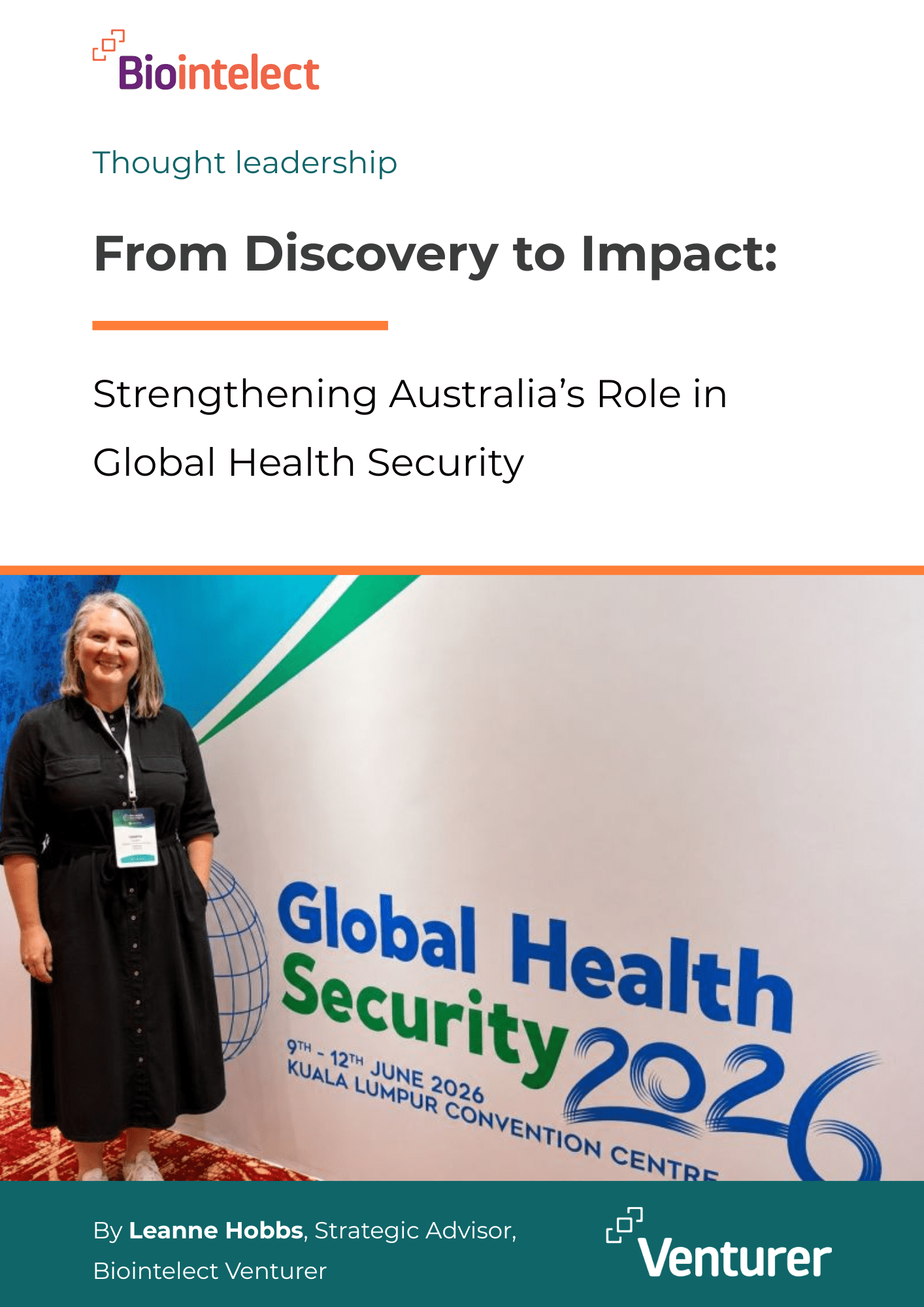
As global health threats grow in complexity and frequency, the gap between scientific discovery and deployable health solutions has never mattered more. Leanne Hobbs, Strategic Advisor at Biointelect Venturer, reflects on the insights from GHS2026 in Kuala Lumpur and what they reveal about Australia’s opportunity to build commercially capable, investment-ready innovation at the frontier of global health security.
Global health security depends on more than government coordination and public health infrastructure. It depends on a steady pipeline of innovations, vaccines, diagnostics, therapeutics, that can be developed, manufactured and deployed when they are needed most. It relies on organisations and individuals building biosecurity into the foundations of programs and approaches, and on public and private investment and partnership. That was the loud consensus at the 4th Global Health Security Conference (GHS2026) in Kuala Lumpur last week, where I presented on Australia’s role in the global infectious disease innovation ecosystem. And it is with these drivers we are seeking to establish Biointelect Venturer as an important catalyst and partner for Australian innovation within the global ecosystem.
Australia has long been recognised for the quality of its scientific research. In vaccines and infectious disease alone, we have generated over 642 patents and conducted more than 300 clinical trials in the past two decades (Linda H.M et al., 2026). Yet only one Australian-developed vaccine has successfully reached the Australian and global market in that same period. The gap is not in our science. It is in everything that comes after.
The Problem Is Not Discovery, It Is Follow-on Funding and Commercial Readiness
The translational gap between a promising result in a lab and a product that impacts the health of individuals and populations is shaped by familiar but stubborn barriers: fragmented funding, limited early-stage capital, insufficient access to manufacturing, and a shortage of the integrated expertise that early-stage innovators need to navigate regulatory, clinical and commercial pathways simultaneously (AVVCC 2024 Outputs). Not to mention the additional challenge for vaccines to address uncertain economic return on investment, particularly for infectious disease that emerge sporadically or unpredictably and in populations with limited purchasing power. These market uncertainties weaken commercial incentives for private investment, despite the potentially significant public health benefits of preparedness and rapid response. COVID-19 served to highlight these barriers and made them impossible to ignore. While Australia’s public health response was widely recognised internationally, the pandemic exposed a sovereign capability gap: as a nation, we were unable to contribute a locally developed product to the global response in the timeframe needed, despite a valiant effort by local researchers.

The lesson is not that Australia needs more discovery research. It is that we need a more deliberate and coordinated investment in building the commercial capability and investment readiness that turns promising science into viable ventures, and viable ventures into products that can be manufactured, regulated and deployed at scale. This is not a new insight. But it remains a persistently underinvested one.
Australia Is Responding — But the Pipeline Needs to Be Built
Since the pandemic, Australia has made meaningful progress on the infrastructure side. Federal and state governments have backed significant investment in manufacturing capabilities, including CSL for tech transfer of the COVID-19 viral vector vaccine, mRNA and RNA technologies and CSIRO’s National Vaccines and Therapeutic Laboratory. Companies including Moderna and BioNTech have established manufacturing presence in Australia. And the launch of the Australian Centre for Disease Control in early 2026 marked an important step toward stronger national coordination.
These investments are necessary and welcome. But manufacturing capacity is only as valuable as the pipeline feeding it. That pipeline does not build itself. It requires sustained, expert support at the earliest and most vulnerable stages of development when the science is promising but the development and commercialisation pathway is unclear, when funding is scarce and the expertise to navigate funding and investor landscapes is hard to access. It was precisely this gap that led to the establishment of Biointelect Venturer in 2025, with funding from the Australian Government through the 2024 Medical Research Futures Fund BiomedTech Incubator Grant Opportunity, to build commercially capable, investment-ready ventures and strengthen Australia’s infectious disease innovation pipeline.
The early response has been insightful. When our first application round opened in December 2025, applications came in from across five Australian states, addressing 20 different infectious diseases a strong signal that the early-stage pipeline exists. It also highlights the need to continue to uncover new technologies and modalities and consider how the incubator can truly service and infectious disease through Australian innovation.
Beyond the individual applications, this dataset offers something strategically valuable: a structured window into where Australia’s infectious disease innovation pipeline, revealing where innovation is concentrated, where translational bottlenecks are most acute, and what the ecosystem most urgently needs. It also provides an insight into local capabilities and technologies in the pipeline that could help Australia prepare and respond to future global health security threats. These insights will continue to build as we open subsequent application rounds. We are currently in final assessment and look forward to announcing our inaugural cohort at the Australian Vaccine Value Chain Conference (AVVCC26) in Sydney in September 2026.
The Opportunity in Front of Us
Australia has world-class science. In the infectious disease and vaccines space, it has growing manufacturing capability, and a national coordination mechanism in the Australian Centre for Disease Control. The foundations are in place. What it needs now is sustained and investment, and commitment to building the commercially capable, investment-ready ventures that can connect these assets and carry Australian innovation from lab to global health impact.
That work cannot wait for the next crisis to demand it. The response capability available in the next health emergency will be shaped by the investments, partnerships and programs being established right now. Australia’s participation in global health security, not just as a beneficiary of global innovation, but as a contributor to it, depends on the pipeline we build in the years before it is urgently needed.
Across Australia, organisations like DMTC and its Health Security Systems Australia (HSSA) division are already doing critical work in translational R&D and collaborative capability development for infectious disease. Biointelect Venturer complements these efforts by strengthening the pathway from discovery to impact, helping innovators build the commercial capability, networks and investment readiness needed to progress promising technologies through funding, expert incubation and commercialisation support. The scale of the opportunity, and the urgency of the challenge with regards to infectious diseases and global health security requires an ecosystem that is aligned around the same conviction: that closing the gap between discovery and impact is not just a commercial imperative, but a health security one.
The conversations at the GHS2026 conference opened doors to multilateral funders, global health security organisations, and international partners across government, philanthropy and the investment community, the kinds of connections that can help Australian innovations find pathways and impact well beyond our own shores.
If you are working in this space — as an investor, researcher, company, policymaker or manufacturer — we invite you to be part of building it. The pipeline is real. The need is clear. And the opportunity to ensure Australian innovation contributes not only to our own preparedness, but to the broader global effort in infectious disease prevention and response, is in front of us now.
Biointelect Venturer is Australia’s national incubator for infectious disease innovation. Established with funding from the Australian Government through the Medical Research Future Fund (MRFF) BioMedTech Incubator program 2024, Biointelect Venturer works with Australian SMEs developing infectious disease innovations to accelerate their path from discovery to impact. Through funding, expert guidance, commercialisation support and strategic partnerships, the incubator is helping build Australia’s pipeline of investment-ready infectious disease innovations and strengthen national and global health security. To learn more or connect with our team, visit biointelect.com.au.
Biointelect is a globally recognised Australian company offering a unique blend of full-service Contract Research Organisation (CRO), regulatory and commercialisation capabilities including both technical, economic and strategic guidance. The organisation’s deep expertise in innovative medicines and vaccines commercialisation – from preclinical to market implementation and policy – underpins the strength of Biointelect Venturer incubator.